 Renzoprotocol
 combines liquid restaking with a newer basis trading strategy
Renzoprotocol, now named Renzo Finance, offers liquid restaking products alongside software that automates a hedged basis trade inside a user-controlled account. The two activities earn through different mechanisms: restaking supports network services, while Basis seeks payments from perpetual futures funding. Those payments can reverse, making the short position pay instead of collect income. The September 9, 2026 rebrand introduced Renzo Basis as the new focus alongside the earlier liquid restaking products. Renzo's product range also includes managed Reserve Vaults and REZ governance, each with separate exposure, fee and withdrawal rules.
Renzo's products differ in exposure and control
Receipt tokens represent collateral within a particular staking or restaking system. The Staking Suite brings supported Ethereum and Solana products into a common interface, where automatic compounding changes the collateral value that a token represents as rewards accrue. The protocol's collateral-per-token exchange rate is separate from the price that a secondary market quotes. Liquidity can affect that trading price even while the token continues to represent its backing. Holders retain a transferable asset, although using it elsewhere adds the rules and risks of the receiving application.
Renzo Basis holds actual trading positions in the user's venue account. Its spot leg owns the selected asset, and its perpetual leg shorts the corresponding exposure. Reserve Vaults allocate deposits across managed DeFi strategies. The gated Enterprise Suite provides institutions with tailored configurations, white-label deployments and monitoring tools. REZ enables protocol governance and also serves as the underlying asset for ezREZ.
The spot holding and perpetual short offset price exposure
A basis trade pairs a long spot holding with a short perpetual position of matching size, aiming to reduce underlying price exposure because gains on one leg offset losses on the other when both prices move together. The short remains subject to margin and liquidation requirements, so balanced exposure can coexist with pressure on its collateral. Hyperliquid executes the crypto Basis implementation.
The listed crypto lineup includes BTC, ETH, SOL, ZEC, HYPE, ENA, PUMP, FARTCOIN and PURR. Each strategy needs an appropriate spot and perpetual pairing. The SPY Basis design pairs spot exposure with a short perpetual on Lighter. Hyperliquid-specific fees, funding mechanics and eligibility cannot automatically apply to that design.
The October 2, 2026 roadmap described additional venues, real-world assets and cross-venue hedging as future developments. Cross-venue hedging separates the spot holding from the venue carrying the short, adding infrastructure dependencies beyond a single Hyperliquid position.
What happens when Basis funding turns negative?
Negative funding makes the Basis short pay the long side, turning the trade's intended income stream into an expense for the position.
Funding responds to the perpetual market's premium relative to its underlying oracle price, together with an interest component. Funding on Hyperliquid settles every hour. The payment amount follows position size multiplied by the oracle price and the hourly funding rate. A rate quoted against position notional does not equal a return against the user's total account equity.
The yield automation evaluates net funding over a configured window before exiting to USDC. A negative hour alone does not trigger this response. The position can incur further funding debits while that window runs, and trading costs affect the eventual net return.
Hedge, yield and margin controls respond to different conditions
Three controls monitor hedge alignment, funding and liquidation distance. Each can run independently or remain in watch-only mode, which records conditions without taking corrective action.
Hedge automation
The hedge control can sell excess spot to restore alignment when the short no longer covers that exposure. This targets the relationship between the legs and leaves other causes of negative returns, including funding costs, in place.
Yield automation
The yield control changes whether the trading position remains open. Watch-only mode records deteriorating funding without submitting an exit order. The existing position then continues to receive or pay funding until another action changes it.
Safety buffer
When margin becomes thin, the safety buffer first uses idle USDC. If that cash is unavailable, it reduces both trading legs. Higher leverage leaves less room for an adverse movement before the short reaches the venue's liquidation threshold.
Automations rely on data delivery, valid trading authorization and executable venue orders. Fast moves or an outage can outrun their response. Liquidation of the short can leave spot exposure unhedged, even if the original trade started market neutral.
A trading key grants limited account authority
The Basis agent key permits strategy trades inside the user's account, including opening, adjusting and closing positions. It cannot withdraw or transfer funds. The account owner retains withdrawal authority and can revoke the key at the venue. Erroneous or compromised trading software can still place harmful orders within its permitted scope. Self-custody therefore leaves meaningful trading and infrastructure risks attached to the account.
Restaking products follow different security networks
Renzo's liquid restaking tokens connect collateral to different security networks, so their reward sources and redemption conditions follow the specific product.
ezETH and pzETH
ezETH represents a restaked EigenLayer position, with ETH or stETH as supported deposits. Staking and restaking rewards compound into its backing value. pzETH links restaked collateral to Symbiotic, where deposits can include stETH, wstETH, WETH or ETH. Its minting ratio follows the pool's collateral relative to token supply. Service rewards depend on collateral deployment and the services actually distributing them.
ezSOL
ezSOL represents exposure to Jito restaking on Solana. Its interface accepts SOL or JitoSOL, but the underlying restaking vault receives JitoSOL. Renzo converts SOL through a swap or direct mint before the vault deposit. Staking, restaking and maximal extractable value rewards compound into the collateral claim without increasing token supply.
ezEIGEN, ezREZ and ezBTC
ezEIGEN represents restaked EIGEN, while ezREZ represents REZ staked through EigenLayer. Renzo delegates restaked REZ to operators that secure AVSs accepting that asset. AVSs are services that use restaked assets for security. Rewards that these products earn compound into their token value. ezBTC represents a WBTC-backed EigenLayer restaking position that retains Bitcoin price exposure. Renzo deprecated its older REZ staking mechanism and requires holders of legacy positions to unstake and migrate manually. An old staked balance does not become ezREZ automatically.
Reserve Vaults introduce managed DeFi exposure
Renzo Reserve Vaults allocate supported deposits to managed strategies, including lending and liquidity provision. Their share tokens represent a vault position, which differs from holding a liquid restaking token directly. The strategy's additional borrowing or market activity adds its own costs and failure conditions.
The ezETH Compound Loop Vault supplies ezETH to Compound, borrows WETH against it and converts that borrowing into more ezETH collateral. Repeated borrowing increases exposure to staking and restaking rewards, while debt interest and liquidation thresholds constrain the return. Vault management monitors loan-to-value ratios and can reduce leverage when conditions change. If ezETH falls relative to WETH, the collateral covers less of the debt. Automation does not remove that relationship or the borrowing cost that the position incurs.
Fees follow trading fills, vault returns or redemption
For the advertised Hyperliquid Basis product, the builder fee is 5 basis points, or 0.05%, on perpetual fills and spot sells. Spot buys are excluded. The product has no management or performance fee, with venue charges still applicable. Enabled automations can generate additional chargeable fills.
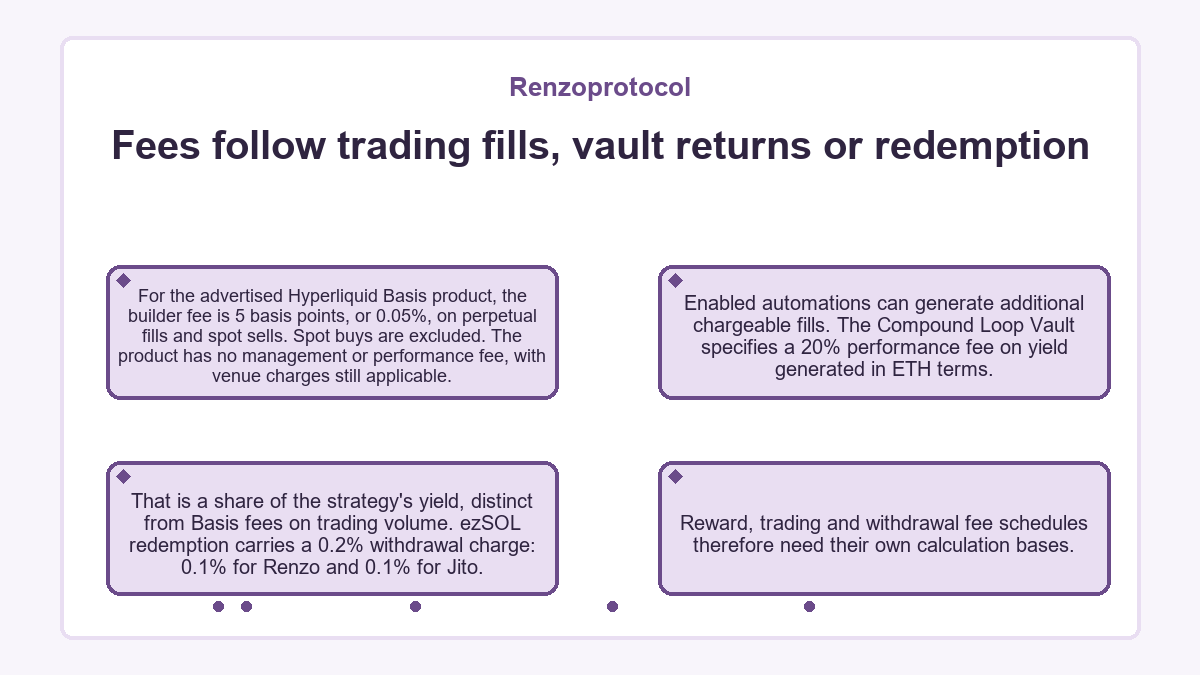
The Compound Loop Vault specifies a 20% performance fee on yield generated in ETH terms. That is a share of the strategy's yield, distinct from Basis fees on trading volume.
ezSOL redemption carries a 0.2% withdrawal charge: 0.1% for Renzo and 0.1% for Jito. Reward, trading and withdrawal fee schedules therefore need their own calculation bases.
Exit times belong to each product and route
Token redemption can require a queue, while closing a Basis trade depends on trading execution rather than a restaking cooldown.
Queued token redemption
Standard ezETH withdrawals on Ethereum mainnet can take up to 15 days, depending on the restaking strategy and validator exit process; initiating that withdrawal stops reward accrual, and the ready balance requires a claim. ezEIGEN, ezREZ and ezBTC use 14-day cooldowns. ezSOL queues redemption for two epochs, described as up to four days. The pzETH withdrawal process has a separate window of 14 to 21 days for returning wstETH.
The Compound Loop Vault gives an estimated withdrawal time of about three days. Its final share-to-WETH conversion uses the lower of the prices at withdrawal request and claim. That pricing condition matters independently of the waiting period.
Buffer-based instant withdrawals
ezETH also has fee-based instant withdrawals, subject to available buffer liquidity. An ezETH instant withdrawal reverts if it would leave the liquidity buffer below the contract's minimum. The fee depends on buffer fullness before and after withdrawal and the configured minimum and maximum rates. A protocol pause disables this route.
Closing the trading position
Renzo Basis has no product cooldown. Unwinding its trading legs still requires executable venue orders. An exit can remain unfinished if liquidity or venue availability prevents completion, and any subsequent bridging introduces the separate provider's settlement conditions.
Does a matched Basis trade have the same exposure as a restaking token?
A matched Basis trade offsets underlying price exposure, while a liquid restaking token retains exposure to its collateral. Suppose both legs hypothetically hold quantity q and their prices each rise by a hypothetical amount d. The spot gains q × d and the short loses q × d. Their combined price profit is q × d - q × d = 0 before funding and costs.
The restaking token continues to represent its collateral claim. Its market value can rise with the underlying asset, while compounded rewards change the backing represented by each token. Unequal fills, diverging prices or loss of the short break the trade's assumed offset. Smart contract failures and slashing can also affect restaked backing independently of market price.
REZ governance concerns protocol decisions
REZ governance covers risk frameworks, collateral choices, operator selection and treasury matters. Eligible holders vote on proposals through Snapshot after a discussion phase. Proposals have their own voting periods and quorum requirements. This participation shapes protocol decisions; it does not establish a fixed yield or convert a governance token into a claim on a Basis account.
Key questions about Renzoprotocol
Will Renzo Basis reopen a position after its funding guard exits?
Renzo Basis does not automatically re-enter after its yield automation exits to USDC. Any subsequent deployment requires a new user decision about the strategy and its settings.
What happens to the trading automations after their key expires?
An expired Basis trading key prevents Renzo's automations from managing the position. The expiry setting can request closure before authorization ends or leave the position open. A requested closure remains a venue order that might not finish during an outage or difficult market conditions. If the position stays open after expiry, it continues without automated management until the user renews authorization or closes it.
Are Renzo Finance strategies available to people in the United States?
Renzo Finance's August 2026 terms prohibit use by United States residents, citizens and people located there. The restriction also covers United States territories and entities incorporated there or with a registered office there. Each execution venue sets additional access conditions. Loading the application or connecting a wallet does not establish eligibility. A venue relaxing its rules does not change Renzo's separate United States restriction.
Does holding REZ in a wallet automatically give it voting power?
REZ held in a wallet needs delegation before its holder can exercise voting power. Holders can delegate to themselves or another address, while ezREZ holdings have automatic self-delegation. Delegation determines who can exercise governance votes.
Are Renzo ezPoints still the current incentive program?
Renzo ezPoints ended on April 28, 2025 and gave way to Renzo Rewards. The replacement uses REZ to incentivize strategic integrations. Season 4 covered December 1, 2024 through March 31, 2025, with a separate claim window from April 30 to May 30, 2025. Those dates belong to the closed season; integration rewards follow their own campaign conditions.