 Renzoprotocol
 requires wallet-held REZ delegation for governance voting
Renzoprotocol requires holders to delegate wallet-held REZ before that balance can contribute voting power to governance proposals. Self-delegation supports direct voting; choosing another address appoints a representative. Legacy staked REZ and ezREZ follow automatic self-delegation rules. Eligibility for an individual proposal also depends on its snapshot, so a later delegation does not rewrite an earlier voting record.
The project adopted the Renzo Finance name on September 9, 2026. REZ governance concerns protocol decisions within that ecosystem. Ownership, delegation and a recorded ballot are distinct states; connecting a wallet does not establish all of them.
Key takeaway: A representative can vote with eligible delegated REZ voting power while the holder retains ownership of the tokens.
Activate voting power without entering a staking position
Self-delegation assigns a wallet's REZ voting units to its own address, allowing the holder to participate directly in governance. It is a governance action on an existing token balance. Depositing REZ to obtain ezREZ changes the holding's representation, while self-delegation changes the address that can exercise voting power. The Ethereum REZ contract supports a direct delegation call and a signature-based delegation method. The holder authorizes the chosen address in either case, and a signature must reach the contract through a successfully executed transaction before it changes onchain delegation. Signing an authorization alone therefore does not establish that the network recorded a new delegate.
Checkpoints connect delegated balances to proposal snapshots
REZ's Ethereum token contract records changes in delegated voting power as checkpoints, preserving an address's voting weight over time. That history lets governance use an earlier state even when the wallet's balance or delegate later changes.
Current voting power
The contract exposes the currently recorded voting units for an address. A representative can accumulate units from several holders, so its voting power can exceed the REZ that it personally owns. The token balance and the delegated vote balance measure different things.
Voting power for an existing proposal
Snapshot fixes a proposal's token-based voting power at its selected snapshot block. The proposal's strategies determine which balances and delegation records enter that calculation. A present-day balance can therefore differ from the weight available for an older vote, because delegation after the selected block does not alter the historical checkpoint.
Eligible holdings follow different delegation rules
Renzo recognizes wallet-held REZ, legacy staked REZ and ezREZ as voting-power categories, with distinct delegation requirements. A specific proposal still applies its own strategies and snapshot to those holdings.
| Holding | Delegation rule | Asset representation |
|---|---|---|
| Wallet-held REZ | Manual delegation to yourself or another address | REZ held directly by the wallet |
| Legacy REZ stake | Automatic self-delegation | Previously staked REZ in the deprecated contract |
| ezREZ | Automatic self-delegation | Liquid token representing restaked REZ |
| The holding's form determines its delegation rule; the proposal determines whether that recorded balance contributes voting power. | ||
The legacy category concerns previously staked REZ. Renzo deprecated that staking mechanism and directs its holders toward manual migration into ezREZ. RP-3 described a gap in voting power from a legacy stake once its cooldown starts. After withdrawal, the holder can restore participation through ezREZ or delegated wallet-held REZ, subject to the proposal's strategies and snapshot.
Representatives receive voting authority over delegated balances
A governance delegate casts votes on behalf of holders who assign voting power to that address. Delegating Ethereum REZ voting power does not transfer ownership of the tokens to the representative. The contract changes vote accounting without creating a token-spending allowance for that representative; an asset transfer or spending approval requires separate authorization.
Renzo encourages delegates to participate in discussions, vote regularly and explain their positions to the holders they represent. A public explanation gives those holders something concrete to assess: the proposal's consequences and the delegate's reasons for supporting or opposing it. The holder can select a different representative through the token's delegation mechanism.
Onchain delegation and Snapshot ballots have different costs
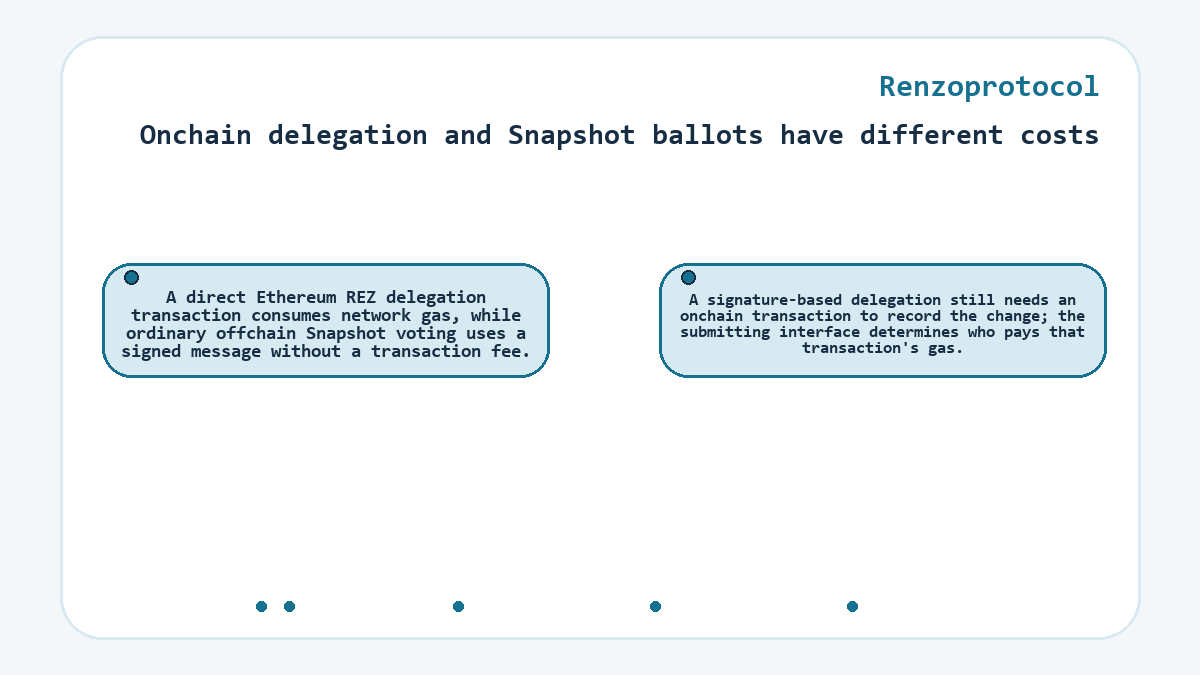
A direct Ethereum REZ delegation transaction consumes network gas, while ordinary offchain Snapshot voting uses a signed message without a transaction fee. A signature-based delegation still needs an onchain transaction to record the change; the submitting interface determines who pays that transaction's gas.
Quorum and approval measure different outcomes
A proposal must meet the applicable participation requirement and approval rule before its governance vote can pass. Quorum measures aggregate voting participation; its threshold does not specify the minimum REZ balance for an individual voter.
Renzo's voting framework includes support, opposition and abstention, with abstaining contributing to quorum without expressing support for the proposed change. Votes carry linear weight under the framework, with the recognized REZ instance affecting the calculation, so counting wallet addresses measures something different from voting power.
Governance can revise quorum and approval thresholds. A proposal with sufficient turnout can still fail when it lacks the support that its approval rule requires.
Proposal content defines the reach of a delegated vote
REZ governance addresses protocol-level choices, including collateral policies, operator selection and treasury spending. Delegated voting power contributes to those collective decisions.
Collateral and concentration limits
Proposals can address deposit assets and concentration amounts alongside broader risk-management frameworks. Those choices affect the protocol's accepted exposures.
Operators and AVSs
Operator and AVS whitelisting also fall within REZ's governance remit. AVSs are services that use restaked assets for economic security. A governance delegate exercises voting rights, while an EigenLayer operator helps secure services that accept restaked assets. The two uses of delegation refer to different responsibilities and assets.
Treasury allocations and community grants
Treasury decisions can direct resources toward community grants and ecosystem initiatives. A grant proposal defines its recipient, allocation and implementation conditions. A passed vote expresses approval; transferring the resources belongs to implementation. Participation in the ballot does not itself distribute treasury assets to voters.
Discussion allows participation before formal voting
Renzo's governance discussion phase welcomes anyone, including participants who do not have eligible voting power. Community members can raise an idea, challenge its assumptions or suggest changes to a draft. A contribution at this stage can affect the proposal that eventually reaches a ballot.
Drafts explain the change's rationale, possible benefits and associated risks, and discussion gives the author a chance to address objections and revise unclear terms before presenting a final version.
Formal proposal creation follows separate submission permissions. Renzo's initial framework restricted it to whitelisted wallets and described broader community submission as a later phase. Holding an eligible voting balance alone does not establish permission to publish a formal proposal.
A discussion post expresses an argument; a ballot records a choice with eligible voting weight. Reading the final proposal matters because revisions can change the commitments that an earlier discussion supported.
Liquid restaking changes the holding beyond its voting rights
ezREZ represents REZ restaked through EigenLayer, where specified operators secure services that accept REZ as an economic-security asset. Its governance eligibility accompanies a restaking position. Rewards that accrue within the product compound into the value represented by the token. The shared liquid-restaking design also appears in ezETH, although ezREZ uses REZ as its underlying asset. Exiting ezREZ involves a withdrawal process with a 14-day cooldown and a manual claim of available REZ; reward accrual stops for the amount that enters withdrawal. Those conditions affect the asset's use beyond governance, especially when immediate access to the underlying REZ matters.
Wallet self-delegation and ezREZ ownership both provide documented ways to participate in REZ governance. Self-delegation keeps the existing wallet-held asset, while ezREZ adds a restaking position and its exit conditions.
Practical questions about Renzoprotocol
Can a REZ voter change a Snapshot ballot before voting ends?
A voter can replace a Snapshot ballot while the proposal's voting period remains active. An accepted replacement vote on the same proposal overwrites that address's previous choice. This changes the ballot, not the historical balances that determine its voting power.
When does a Renzo proposal stop accepting votes?
A Renzo Snapshot proposal stops accepting votes at its announced end time. The initial governance framework specified a five-day voting period and allowed later updates. The dates attached to an individual proposal determine its actual voting window; the original duration does not establish a permanent schedule for every future vote.
Are REZ holdings on different networks automatically combined for governance?
REZ holdings on different networks count together only when a proposal's voting strategies include those holdings. REZ has deployments on Ethereum, Base and Solana. Each strategy specifies the asset and network that it reads. A matching ticker alone does not activate a combined voting balance across those separate networks.
Why can Snapshot fail to calculate voting power after REZ delegation?
A voting-power calculation error can reflect a configuration problem or a blockchain data node that fails to respond. It differs from a successful calculation that returns zero eligible voting power. A confirmed REZ delegation does not remove those infrastructure dependencies. Retrying after service access recovers can resolve a request failure, while balances missing at the proposal's snapshot remain excluded.
Must a self-delegating REZ holder publish a delegate pitch?
Self-delegation does not require a forum pitch. A pitch introduces someone who seeks voting power from other holders. Renzo's delegate nomination process asks candidates to provide an address and describe their intentions and background. Ethereum REZ's token-level self-delegation simply selects the holder's own address as the delegate.
Does Ethereum REZ delegation let one wallet divide voting units between several delegates?
Ethereum REZ's token-level delegation assigns a wallet's voting units to one delegate address at a time. Its ordinary delegation function accepts a single recipient and applies to that wallet's voting units. It does not accept a percentage allocation across multiple representatives.
What happens to delegation when REZ moves into a different wallet?
The receiving address retains its own delegate setting after an Ethereum REZ transfer. The contract adjusts voting units against each address's recorded delegate instead of copying the sender's choice. A receiving wallet without an existing delegate therefore needs its own delegation to activate token-level voting power. An existing proposal continues to use its historical snapshot.